Sep. 14th and 15th
Not much to report. Shannon was really tired and achy all weekend.
Sep. 16th
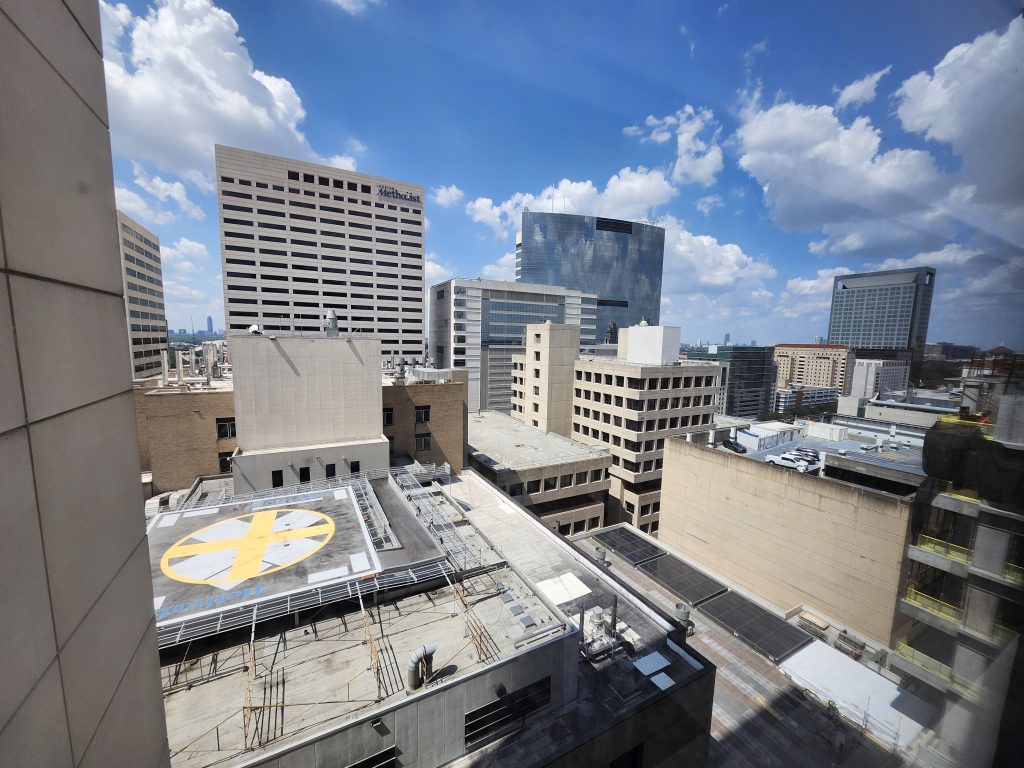
We had a meeting at Methodist Hospital with the BMT Social Worker and aslo with the BMT doctor. (BMT = Bone Marrow Transplant)
First we went to the Outpatient Building across the street from the main hospital to meet with the BMT Social Worker. She was very friendly and basically just interviewed Shannon to see how many family members lived in our home, and who her primary support would be. She has to have someone with her 24/7 at home after the transplant. She told us a little about what to expect and also said we’d have to attend a class about bone marrow transplant, and be receiving a book that explains everything.
After we finished with the Social Worker, we went back downstairs and across the skybridge that connects to the main hospital. We went up to the 15th floor of the Walter Tower to the actual BMT Unit. We checked in and had to wash our hands and mask up. It’s a “closed unit.” So basically you can’t just walk onto the unit, the doors remain closed and there’s a receptionist you have to check-in with before entering. There’s only 1 person allowed with the patient at any time. The rules are very strict but this is to minimize germs brought into the unit. Every patient going thru bone marrow transplant is immunocompromised for a period of time and infections could be fatal.
We were on the actual unit but in an exam room. A nurse aide came in and performed a 12 Lead EKG on Shannon and took her vital signs. Then 2 nurses came in and reviewed all of her current medications and history. Then the bone marrow transplant doctor, Dr. Hill, came in. She explained that Shannon has 9 matches in the Bone Marrow Donor program that are a “Full Match” 10 out of 10 HLA match. Shannon’s daughter Jesslyn, son Q’elli, brother Anthony and brother Richard were all “Half Matches” or around 5 to 6 out of 10 HLA Match.
HLA stands for human leukocyte antigens. HLA are proteins—or markers—on most cells in your body. Your immune system uses HLA to see which cells belong in your body and which do not. You have many HLA markers. To match patients and donors or cord blood units for blood stem cell transplants, doctors use HLA typing to look at specific HLA markers. HLA matching is much more complicated than blood typing.
https://www.nmdp.org/patients/understanding-transplant/finding-a-donor/hla-typing-matching
Dr. Hill explained that even though there’s donors in the registry that are 10/10, they have similar outcomes with half-matched 5/10 sibling or child donors. She said there’s lots of potential problems with using someone in the registry. The team may be unsuccessful contacting them, they may have changed their mind about being a bone marrow donor, and the logistics and timing of getting their donated marrow from another location and transporting it to Houston Methodist for Shannon’s transplant. She said it’s just way easier to use a close family member that we know will donate and they’re local so that all of the testing and preparation can take place smoothly.
Shannon has her 4th cycle of chemo scheduled for next week (hospital admission at St. Luke’s). Dr. Hill said that will likely be her last chemo cycle. After that cycle, she will rest up and recover for 3-4 weeks then she’ll be admitted to Houston Methodist Bone Marrow Transplant Unit for an entire month. She said since Shannon we believe Shannon is in remission, there’s no reason to wait any longer or do more chemo. The chemo is harsh on the body so using the least amount necessary is best. We still have to wait for the results of 1 last bone marrow biopsy to see the status of Shannon’s leukemic cells and know for sure she’s in remission. However, the last bone marrow biopsy was after her 1st cycle. They said the leukemic cell counts were so low at that time, she was basically in remission or near remission. She’s since recieved 2 more cyles of chemo and will have her 4th next week. So, their pretty sure she’ll be in remission and we can go ahead with the transplant.
To review from months ago, the Bone Marrow Transplant is needed to keep the leukemia from returning. The chemo kills the leukemia and the transplant helps to keep it from coming back. The type of cancer Shannon has is known to come back if only chemo is used. That’s why her doctor told us from the beginning that a transplant would be required.
They gave us some more info during the meeting regarding the tranplant and what happens afterwards. Basically the 1st 100 days they’ll be keeping a very close eye on Shannon. We have to live within 1 hour of the hospital (we’re about 45 min away, 60 min with traffic). After her 30 days of inpatient for the transplant, she will have to visit the clinic for checkups and labs 3x a week. The biggest thing they’ll be watching for is GVHD (Graft Versus Host Disease).
In graft vs. host disease (GvHD), the donated stem cells you receive during an allogeneic stem cell transplant view your body’s cells as a threat and attack. There are two main types of GvHD: acute GvHD and chronic GvHD. Treatments include drugs that suppress (calm) your immune system.